카테고리
Introduction to Titanium Anodes for Hydrometallurgy
Gr1 or Gr2 pure titanium mesh as substrate, lead dioxide as coating by electroplating technique.
The connection is titanium claded copper that is welded together with the anode.
Mar 26th,2025
292 견해
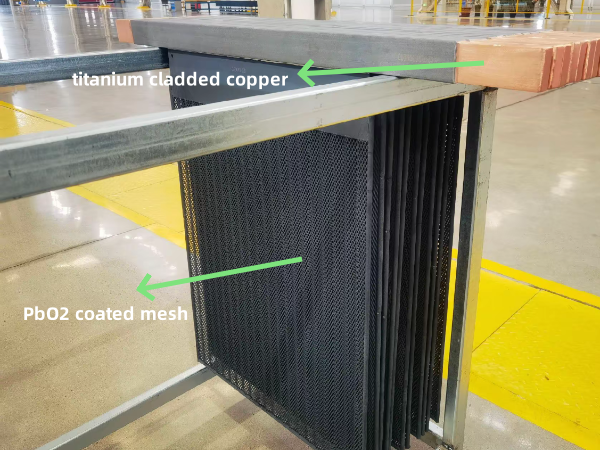 1. Application areas: Electrodeposited copper, nickel, cobalt, zinc and other non-ferrous metals2. Product specifications: Processing according to drawings3. Anode lifespan: Over 2 years4. Coating type: Titanium based lead dioxide anode5. Electrochemical performance and lifespan testing (refer to standard HG/T2471-2007 Q/CLTN-2012)Coating thickness: 3mmOxygen evolution potential: <1.73vTest conditions: 15% HSO4CL content: <2g/LLifespan: >500h6. Technical indicators of titanium based lead dioxideA. Technical performance of insoluble anode plate(1) The anode plate is coated with a titanium based precious metal intermediate layer, α - pbO2 and β - PbO2, and the conductive rod is made ofTitanium copper composite rod: The anode plate and conductive rod are connected by welding.(2) The thickness of the substrate titanium mesh is 2mm, the thickness of the coating on one side is not less than 0.6mm, and the thickness of the finished product is not less than3.5mm; The board surface should be flat, and there should be no layering, cracks, or other inclusions on the finished product surface.(3) Verticality of the board surface: The upper and lower parts of the board surface have an error of less than ± 6mm(4) Lifespan: Corrosion resistant, bending resistant, with a lifespan of over 2 years(5) After processing, it is required that the plane tolerance and surface tolerance be less than ± 5mm, and the diagonal tolerance be less than 3mm(6) Strictly follow the drawings for processing
B. Electrochemical performance of insoluble anode plate
Finished anode plate conductivity: 4-5 * 10-5 Ω;
Surface hardness: HRC=11
Oxygen evolution overpotential: 1.73-1.9v (Vs.SCE, 150g/L sulfuric acid, 1000A/m2)
7. Actual usage data
A. Actual usage data of 10000 tons of electrolytic nickel per year
Project name: Lead dioxide anode for nickel production system
Purpose of use: 1. Cost effectiveness of lead dioxide anode in electric nickel system and iridium tantalum anode
2. The effect of corrugated plate lead dioxide anode on cathodic nickel deposition
Operating conditions: pH=1.5, sulfuric acid: 40g/L, nickel sulfate: 40-55g/L
Boric acid: 5-7g/L Temperature: 70 ° Pole spacing: 60-70mm (with diaphragm bag)
Chloride ion:< 1g/L
Anode size: 4 * 820 * 1260 (lead dioxide) 4 * 760 * 820 (iridium tantalum) 8 * 760 * 820 (lead plate)
|
Anode
|
Current density A/m2
|
Cell voltage
V
|
Current Efficiency
|
Working Life
|
|
Pb anode
|
180-230
|
3.9-4.6
|
89%-91%
|
12-18 months
|
|
Ir-Ta coated titanium anode
|
180-230
|
3.4-4.0
|
93%-95%
|
more than 24 months
|
|
PbO2 coated titanium anode
|
180-230
|
3.8-4.5
|
92%-94%
|
more than 24 months
|
|
Anode
|
Current density
A/m2
|
Cell Voltage
V
|
Current Efficiency
|
Working Life
|
|
Pb Anode
|
180-210
|
2.-2.1
|
89%-91%
|
12 months
|
|
PbO2 coated titanium anode
|
180-210
|
1.9-2.1
|
92%-94%
|
more than 24 months
|

